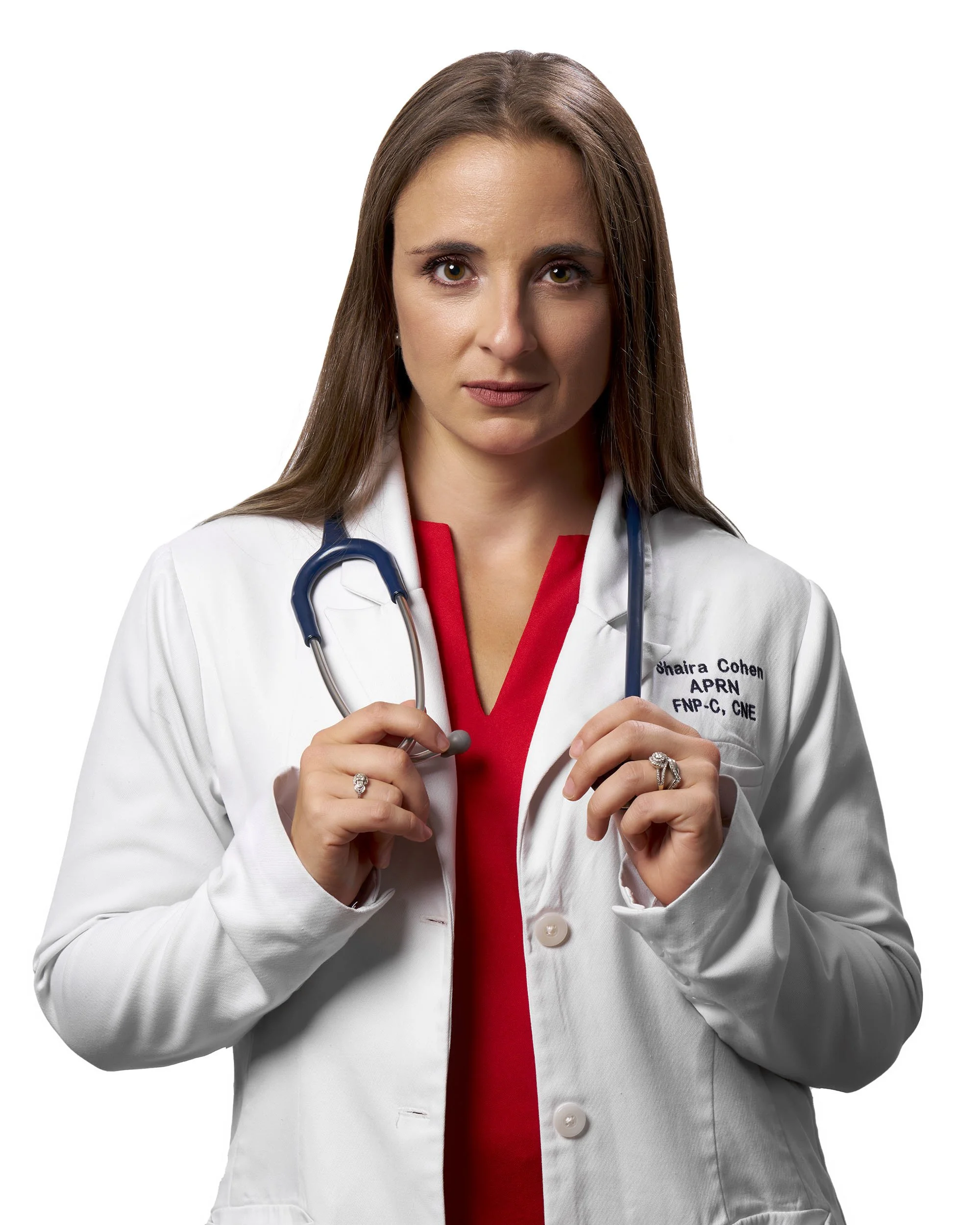
Last updated: May 2026 — Reviewed by Shaira Cohen, MSN, APRN, FNP-C, CNE
Burn assessment shows up on nearly every nurse practitioner board exam, and the Rule of Nines for burns is the single most testable concept in that topic. If you can quickly estimate total body surface area (TBSA), classify burn depth, and apply a fluid resuscitation formula, you can answer almost any burn question the AANP or ANCC throws at you.
This guide walks through the Rule of Nines, how it differs in children, when to use alternative estimation methods, and how TBSA feeds directly into the Parkland formula. You will also find a comparison table, board-style practice questions, and the referral criteria examiners love to test.
Mrs. Cohen explains this in detail and goes over a few sample questions on the video below.
What Is the Rule of Nines for Burns?
The Rule of Nines is a rapid bedside method for estimating the percentage of TBSA affected by a burn. It divides the adult body into regions that each represent 9% — or a multiple of 9% — of the total surface area. Because the math is fast and requires no chart, it is the go-to tool in emergency and prehospital settings.
TBSA estimation matters because it drives two critical decisions: how much intravenous fluid the patient needs and whether the patient requires transfer to a specialized burn center. An inaccurate estimate leads to either dangerous under-resuscitation or fluid overload.
The Adult Rule of Nines Breakdown
In an adult, the body surface is divided as follows:
- Head and neck: 9% (4.5% anterior, 4.5% posterior)
- Each arm: 9% (4.5% anterior, 4.5% posterior)
- Each leg: 18% (9% anterior, 9% posterior)
- Anterior trunk: 18% (chest and abdomen)
- Posterior trunk: 18% (back)
- Perineum/genitalia: 1%
These regions add up to 100%. A useful exam shortcut: a burn covering the front of one leg and the front of the trunk is 9% + 18% = 27% TBSA.
Key point for boards: Only partial-thickness and full-thickness burns are counted in TBSA. Superficial (first-degree) burns such as sunburn are excluded from the calculation.
The Rule of Nines in Children
Children are not small adults. Infants and young children have proportionally larger heads and smaller legs, so the adult Rule of Nines overestimates leg burns and underestimates head burns in this population.
For a rough pediatric adjustment, an infant's head accounts for roughly 18% of TBSA, while each leg accounts for roughly 14%. As the child grows, the head percentage decreases and the leg percentage increases until adult proportions are reached around age 10 to 14.
Because these proportions shift continuously with age, the Rule of Nines is less reliable in pediatrics. For children, the Lund-Browder chart is the preferred and most accurate tool because it assigns surface area values by specific age group.
Alternative TBSA Estimation Methods
The Rule of Nines is not the only method, and the boards expect you to know when each is most appropriate.
The Palmar Method
The patient's palm — including the fingers — represents approximately 1% of their TBSA. This method is best for small, scattered, or irregularly shaped burns where the Rule of Nines would be clumsy. Note that it is the patient's palm, not the clinician's.
The Lund-Browder Chart
The Lund-Browder chart is the most accurate method for estimating TBSA, especially in children, because it accounts for age-related changes in body proportion. It is more time-consuming, so it is typically used in the burn unit rather than in the field.
Comparison of TBSA Estimation Methods
| Method | Best Used For | Accuracy | Speed |
|---|---|---|---|
| Rule of Nines | Adults, large burns, rapid field assessment | Moderate | Fast |
| Palmar (1%) method | Small or patchy burns | Moderate | Fast |
| Lund-Browder chart | Children; precise in-hospital estimation | High | Slower |
Classifying Burn Depth
TBSA tells you how much surface is burned; burn depth tells you how severe each area is. Both are tested heavily.
- Superficial (first-degree): Epidermis only. Red, painful, dry, no blisters; blanches with pressure. Example: sunburn. Not counted in TBSA.
- Superficial partial-thickness (second-degree): Epidermis and upper dermis. Painful, moist, red, blisters, blanches. Heals in 2 to 3 weeks.
- Deep partial-thickness (second-degree): Extends into deeper dermis. Less painful, may appear white or mottled, slower capillary refill. May require grafting.
- Full-thickness (third-degree): Destroys epidermis and entire dermis. White, leathery, or charred; painless in the burned area because nerve endings are destroyed. Requires grafting.
- Fourth-degree: Extends into muscle, fascia, or bone. Life- and limb-threatening.
A classic exam distractor: a patient with a large full-thickness burn who reports no pain in the burned area. The absence of pain is a sign of depth, not a sign of a minor injury.
From TBSA to Fluid Resuscitation: The Parkland Formula
Once you have an accurate TBSA, you can calculate fluid needs. The Parkland formula is the most commonly tested:
Parkland formula: 4 mL × body weight (kg) × %TBSA = total lactated Ringer's in the first 24 hours.
Administer half of that total in the first 8 hours, measured from the time of the burn (not the time of arrival), and the remaining half over the next 16 hours.
Worked Example
A 70 kg adult with 40% TBSA partial- and full-thickness burns:
- 4 mL × 70 kg × 40 = 11,200 mL lactated Ringer's in 24 hours
- First 8 hours: 5,600 mL (≈ 700 mL/hour)
- Next 16 hours: 5,600 mL (≈ 350 mL/hour)
The single best indicator of adequate resuscitation is urine output: target 0.5 mL/kg/hour in adults and 1 mL/kg/hour in children. Formulas are only a starting point — titrate to that endpoint.
Many burn centers now begin resuscitation at 2 mL/kg/%TBSA (the modified Brooke approach) to reduce the risk of "fluid creep" and over-resuscitation, then titrate up to urine output. For board purposes, know the classic Parkland 4 mL formula but recognize that titration to urine output supersedes any fixed calculation.
When to Refer to a Burn Center
Examiners expect you to recognize burns that exceed primary-care or general-ED management. Refer to a specialized burn center for:
- Partial-thickness burns greater than 10% TBSA
- Burns involving the face, hands, feet, genitalia, perineum, or major joints
- Full-thickness burns in any age group
- Electrical burns (including lightning) and significant chemical burns
- Inhalation injury
- Burns in patients with complicating comorbidities or at the extremes of age
- Suspected non-accidental injury (abuse) in children
Board-Style Practice Questions
1. An adult sustains partial-thickness burns to the entire anterior trunk and the entire anterior surface of both legs. Using the Rule of Nines, what is the estimated TBSA?
Show Answer
2. An 80 kg patient has 30% TBSA partial- and full-thickness burns. Using the Parkland formula, how much lactated Ringer's should be given in the first 8 hours?
Show Answer
3. Which finding is the single best indicator of adequate fluid resuscitation in an adult burn patient?
Show Answer
4. A patient's burn is white, leathery, and painless on examination. What burn depth does this describe?
Show Answer
FAQ
How do you calculate TBSA using the Rule of Nines?
Why is the Rule of Nines different for children?
What is the Parkland formula for burns?
Are first-degree burns included in TBSA?
What does the palmar method estimate?
Conclusion
The Rule of Nines for burns is a high-yield, high-frequency board topic because it connects assessment directly to life-saving treatment. Remember the adult regional percentages, recognize that children need the Lund-Browder chart, exclude superficial burns from TBSA, and know that the Parkland formula gives a starting point that you titrate to urine output.
Ready to lock this in before exam day? Work through timed burn and emergency-management scenarios in The Cohen Review Question Bank, or build complete mastery with The Full Package board prep course.
Sources:
“Burn Patient Referral Guidelines | American Burn Association.” Ameriburn.org, 2025, www.ameriburn.org/burn-care-team/resources/guidelines-for-burn-patient-referral.